

Published on: September 2, 2026
What Determines the Right
Configuration?
Off-grid lighting is becoming an increasingly practical option for remote, industrial, and infrastructure projects. But reliable performance depends on more than selecting a large solar panel and battery. The real engineering challenge is achieving the right balance between lighting demand, available solar energy, and stored capacity.
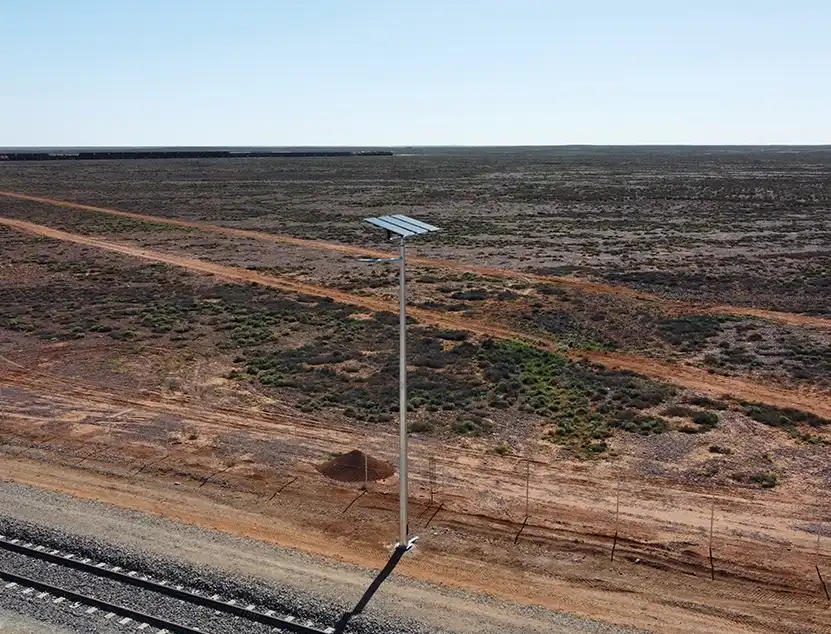
For sites where connection to mains of power is difficult, costly or impractical, solar lighting can eliminate significant electrical infrastructure.
There is no trenching for power, no long cable runs, and no ongoing reliance on the electricity network.
But going off-grid introduces a different design challenge.
The lighting system has to produce, store and manage every watt of energy it consumes.
That makes system sizing one of the most important considerations in an off-grid lighting project.
And despite the way solar products are sometimes compared, panel wattage or battery capacity alone tells only part of the story.
A reliable system depends on the relationship between lighting load, operating hours, available solar energy, panel capacity, battery storage, autonomy, and the conditions at the installation site.
Get that balance right and solar can provide reliable lighting in locations where conventional electrical infrastructure is difficult to justify.
Get it wrong and even a system with a large panel or battery can eventually run short of energy.
The calculation starts with the light, not the solar panel
The first question in solar system sizing shouldn’t be “How large does the solar panel need to be?”
It should be:
“What does the lighting need to achieve?”
Required illumination, pole height, spacing, optical distribution and luminaire output determine the lighting solution. From there, the electrical load can be established.
At its simplest, nightly energy demand can be considered as:
Energy demand (Wh) = luminaire power (W) × operating time (h)
A 20 W luminaire operating continuously for 12 hours would therefore have a theoretical nightly energy requirement of 240 Wh.
But real-world installations are rarely that simple.
A remote access road may experience significant activity around shift changes and very little activity overnight. A pedestrian area might require higher illumination during the evening but only background lighting later at night. A mine or industrial facility may require more consistent illumination throughout its operating period.
This means two projects using the same luminaire could require very different solar configurations.
Why does the operating profile matter?
One of the most powerful variables in solar lighting design is not solar panels or batteries.
It is when and how the light operates. Rather than operating at maximum output throughout the entire night, an intelligently controlled system can vary from output according to the needs of the site.
Higher illumination might be provided during periods of activity, followed by reduced output overnight. Motion detection can then increase output temporarily when vehicles or pedestrians enter the area.
This can substantially reduce total nightly energy consumption without necessarily compromising the lighting required when the site is being used.
It also changes the solar calculation.
Reducing the average load means less energy needs to be generated and stored potentially changing the panel and battery capacity required for the application.
For this reason, operating profiles should form part of the initial system design rather than being treated as a control setting added after the hardware has been selected.
A solar system in Sydney isn’t the same as one in Hobart or the Pilbara
Solar availability varies significantly across Australia and throughout the year. Australian Government guidance identifies geographic location, climate, season, panel orientation, slope, shading and contamination among the factors that can affect photovoltaic generation.
For off-grid lighting, the seasonal element is particularly important.
A system cannot simply be designed around average annual or favourable summer solar conditions. It must remain capable of supporting the required lighting performance when solar generation is lower and nights may be longer.
This is where solar lighting becomes a genuine engineering exercise rather than simply a product selection exercise.
The available solar resource needs to be considered alongside the expected load and the reserve capacity required by the site.
Bigger isn’t necessarily better
It is tempting to approach solar lighting conservatively by simply increasing panel and battery size.
But the two components solve different problems.
The solar panel generates energy.
The battery stores energy.
A larger battery can provide greater stored capacity, but it cannot correct a system that consistently consumes more energy than its solar panel can replenish.
If the daily energy balance remains negative, a larger battery may simply take longer to discharge.
Similarly, increasing panel capacity without providing appropriate storage may not deliver the reserve required to operate through periods of poor solar conditions.
The objective is therefore not to maximise individual components.
It is to balance generation, storage and consumption.
The importance of autonomy
This balance becomes particularly important when considering battery autonomy.
Solar generation changes from day to day. Cloud cover and seasonal weather conditions can reduce the energy available to recharge the battery.
An off-grid lighting system therefore needs sufficient reserve capacity to continue operating through periods when solar generation is below normal.
For critical industrial, mining, or infrastructure applications, this can be an important operational consideration.
Tigerlight’s Corso Solar systems, for example, can be engineered for up to 72 hours of autonomy depending on the configuration, lighting load, operating profile and site conditions.
But autonomy should never be considered by battery capacity alone.
The useful question is not simply:
“How large is the battery?”
It is:
“How long can this complete system support the required lighting profile under the expected site conditions?”
That distinction provides a much more meaningful measure of off-grid system performance.
Site conditions can change the calculation
Even a well-modelled system still needs to operate in the real world.
A solar panel installed beside an open regional road may have excellent solar exposure. The same panel installed beside a processing plant; warehouse or mature vegetation may experience significant periods of shading.
Dust, dirt, and other contamination can also reduce solar capture over time, particularly in mining, agricultural, and industrial environments.
Panel orientation and tilt are equally important.
These factors need to be identified during site assessment because they influence how much energy the system can generate.
For this reason, selecting a solar lighting system purely from a product specification sheet can be misleading.
The site is part of the system.
Lighting efficiency is part of solar efficiency
There is another part of the energy equation that can easily be overlooked: the luminaire itself.
Good optical design can reduce the amount of electrical power required to achieve the lighting objective.
Rather than simply increasing lumen output, the correct optical distribution can place light where it is needed while controlling unnecessary spills, glare and wasted light.
This becomes particularly important where projects also need to consider obtrusive light requirements or neighbouring properties.
Every watt of lighting that isn’t required is a watt the solar system doesn’t need to generate and store.
In that sense, efficient solar lighting begins with an efficient lighting design.
One luminaire. Two very different solar systems.
Consider two hypothetical projects using a similar LED area luminaire.
The first is a public pathway where activity is concentrated in the early evening. Lighting can operate at higher output during that period, reduce overnight, and increase again when movement is detected.
The second is a remote industrial access area supporting continuous overnight operations. Consistent illumination is required for vehicles and personnel throughout the night.
The luminaire may be identical.
The pole may even be identical.
But the energy requirement is not.
The second application may consume significantly more energy each night, requiring a different combination of solar generation, battery storage, and system programming.
This is why selecting solar lighting according to luminaire wattage alone misses a significant part of the engineering calculation.
From product selection to system configuration
Modern commercial solar lighting increasingly allows these variables to be configured rather than treated as fixed.
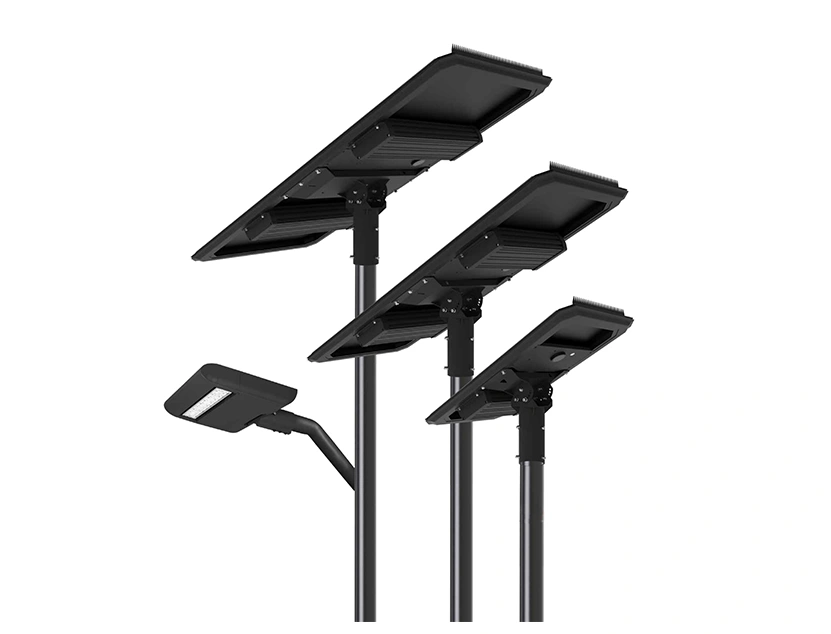
Tigerlight’s Corso Solar Engine range, for example, combines solar generation, LiFePO₄ battery storage and programmable MPPT control within systems designed for different load requirements.
The range includes 55 W, 110 W, and 175 W solar configurations, with different battery capacities and programmable lighting output, operating schedules, and motion response.
Rather than simply selecting a larger or smaller solar product, the objective is to match the system to the site’s lighting requirement, solar resources, and operating behaviour.
It is a subtle distinction, but an important one.
Solar lighting should be specified as a complete energy and lighting system, not as a collection of individual components.
The right configuration starts with the right questions
Before specifying an off-grid lighting system, there are several questions worth answering:
- What lighting level and distribution does the application require?
- What is the total electrical load?
- How many hours will the lighting operate?
- Does it need full output throughout the night?
- Could dimming or motion control reduce unnecessary energy consumption?
- What solar resource is available at the site?
- Are there seasonal limitations or potential shading?
- How much autonomy does the application require?
- What environmental conditions could affect long-term performance?
Only when these variables are considered together can the appropriate panel, battery, luminaire and control configuration be determined.
Engineering the energy balance
The appeal of solar lighting is easy to understand.
For remote roads, mining infrastructure, pathways, compounds, car parks and other difficult-to-power areas, eliminating trenching, cabling and grid connection can significantly simplify the infrastructure required to provide lighting.
But the absence of electrical infrastructure doesn’t mean engineering disappears. It moves into the solar system itself.
Reliable off-grid lighting ultimately comes down to maintaining an energy balance:
The energy available to the system must be capable of supporting the energy the site requires.
That requires lighting design, solar generation, battery storage, controls, location and operating conditions to be considered as one system.
Need support with your solar lighting design?
Tigerlight designs and supplies industrial LED and solar lighting solutions for mining, infrastructure, industrial and public-space applications across Australia. The Corso Solar range combines solar generation, LiFePO₄ battery storage, programmable control and purpose-selected LED luminaires to deliver reliable off-grid lighting.
If you’re assessing a site or unsure which solar configuration is right for your project, talk to our team. Tigerlight’s lighting design team can assess your site requirements, operating profile and lighting objectives to develop a lighting design and recommend an appropriate solar configuration.